Grinding Media: Size, Charge and Consumption
Grinding media is the consumable that turns a rotating shell into a mill.
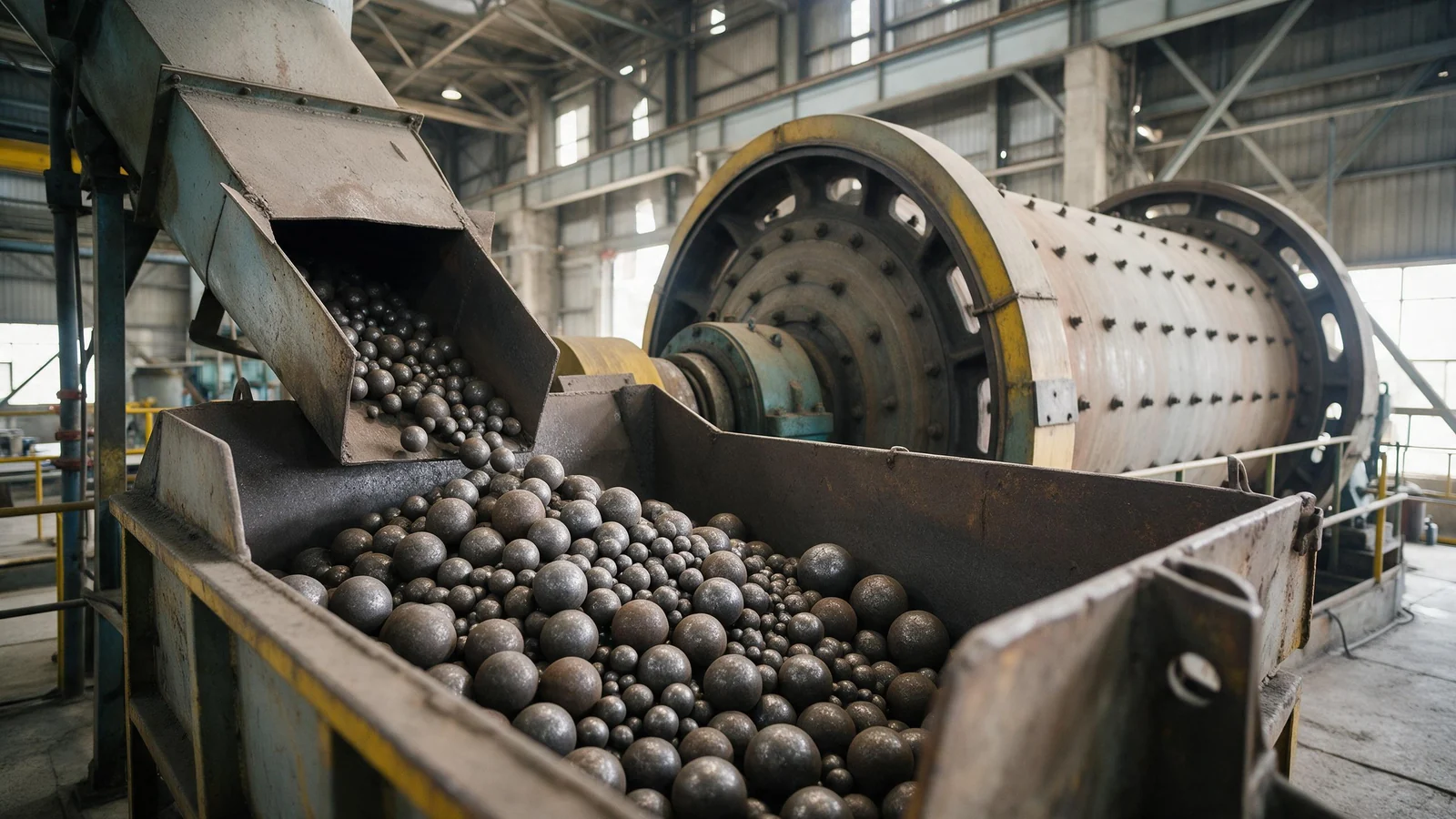
Grinding media is the loose charge of steel balls or rods inside a rotating mill that breaks ore by impact and attrition. You'll find it in every wet or dry grinding circuit, from a 500 t/d gold plant to a 50,000 t/d iron concentrator. Selecting the right media size and ball charge isn't a one-time calculation; it's an operating decision that affects throughput, product fineness, liner life, and power draw. Xinhai reports more than 600 mine EPC+M+O projects, according to the company's published figures, and grinding media selection is a recurring decision in many of those flowsheets. The full equipment range is listed in the grinding equipment catalogue.
How media size follows feed top size
Media size selection begins with the largest particle you expect in the mill feed. Oversized balls waste energy lifting dead weight; undersized balls can't break the coarsest rocks efficiently. A standard approach is to size the largest ball so that it will fracture the coarsest feed particle under the prevailing impact conditions. Designers then select a graduated media charge, with the largest balls at the feed end and smaller balls toward the discharge end. The distribution is usually expressed as a top size plus a percentage of lower sizes. For a given ore, the Bond work index (measured in kWh/t) is a common measure of grindability. More competent ores demand a larger top size or a higher proportion of large balls. Xinhai's ball mills are built up to φ7 m in diameter, so the practical media diameter range fits both small regrind mills and large primary mills. You'll rarely need a single size; the charge is a blend, not a monochrome load.
Ball charge volume as a percentage of mill volume
The ball charge volume is the fraction of the mill's internal volume occupied by grinding media, expressed as a percentage. This number drives power draw, throughput, and the severity of impacts on the liner. Too small a charge doesn't generate enough impacts or attrition. Too large a charge wastes motor power and can reduce the mill's ability to tumble the load. The operating window is a balance, and it changes with mill speed and liner profile. You'll see the charge volume listed in equipment specifications as a maximum or a recommended range. Xinhai's selection tables include effective volume and maximum ball charge for each mill model. When you compare mills, don't look at total installed power alone; check the charge volume that the shell and trunnion can actually support. The charge volume and the liner profile work together—the liner lifts the charge, while the media does the grinding. If you're evaluating liner wear patterns, read the corresponding guide on ball mill liner selection.
Forged vs cast grinding media
Grinding media comes in two broad families: forged steel balls and cast steel or cast iron balls. Forged balls are produced by mechanically deforming a steel billet at high temperature; this refines the grain structure and gives higher impact toughness. Cast balls are poured into molds, which allows complex shapes and lower production cost, but the as-cast structure can contain more internal voids or segregation unless heat-treated. In practice, you'll choose forged media for high-impact duties—large-diameter balls in SAG or primary ball mills—where breakage is a bigger risk than wear. Cast media often works well in smaller regrind mills where impact is lower and wear is more abrasion-dominated. The decision is never purely about media price; breakage consumes media faster than wear, and broken ball fragments can damage liners and pumps. Xinhai's advanced materials manufacturing base produces wear-resistant rubber and polyurethane products, but the media itself is typically sourced as steel or high-chrome alloy. Always confirm the microstructure and hardness profile with the supplier, not just the chemistry.
What drives media consumption
Media consumption is the mass of grinding media lost per tonne of ore ground, usually expressed in kg/t or g/t. Four operating factors dominate: ore abrasiveness, mill speed, corrosion, and media quality. Abrasive ores like quartzite wear media faster than soft limestone; the Bond abrasion index (Ai) is a standard measure. Mill speed matters because the charge motion changes from cascading to cataracting as speed increases. Cascading produces more attrition and lower impact, while cataracting adds high-energy impacts that can accelerate both breakage and wear. Corrosion is the hidden cost in wet grinding. Water, dissolved oxygen, and process chemicals attack steel surfaces even when no ore is present. In gold circuits, cyanide leaching solutions are particularly aggressive toward steel; the International Cyanide Management Code sets operational guidance for cyanide use, and corrosion control is part of that picture. For commodity context, the USGS Mineral Commodity Summaries reports that lithium-ion batteries account for 88% of global lithium use—a reminder that grinding circuits exist across every commodity, each with its own abrasion and corrosion profile.
Managing consumption through circuit design
You don't reduce media consumption by buying cheaper balls alone. The bigger lever is circuit design. Closed-circuit grinding with a classifier returns oversize to the mill, which prevents overgrinding and preserves media. Xinhai's classifying equipment range includes hydrocyclones and spiral classifiers that close the loop. Operating the mill at the right percent of critical speed and maintaining the correct pulp density also keeps media working on coarse particles instead of wearing on fines. Another practical move is to monitor the charge level and top it up in small, frequent additions rather than large slugs. Frequent small top-ups keep the size distribution stable and reduce impact damage on the liner. If you're doing a flowsheet review, start with the selection guides to see how grinding fits the whole plant.
Xinhai's approach to grinding media selection
Xinhai's engineering process ties grinding media selection to test work and flowsheet design. The company's CNAS-accredited laboratory and industrial pilot base run grindability tests and batch grinding trials before equipment is sized. Xinhai reports more than 2,500 mines served across 100+ countries, according to the company's published figures, and 700+ technical experts work across 70+ ore types. That breadth matters because media behavior is ore-specific. A plant running 1,200 t/d of fluorite will need different media than a 3,000 t/d gold operation. When you work through an EPC or equipment supply scope with Xinhai, the media selection is part of the process package, not an afterthought. To discuss your circuit, contact the engineering team through the contact page.
A step-by-step check for grinding media charge
A grinding media charge is the blend of steel balls or rods that occupies the mill volume; the goal is to keep that blend constant, not to chase a single size. When you audit an existing mill, work through these five steps before changing media. First, record the mill inside diameter in metres and the effective grinding length. Second, open the mill and measure the charge level relative to the centreline, then convert that to a percentage of internal volume, because charge volume is a fraction of the mill's internal volume. Third, screen a representative sample of the loaded media and record the top ball size in millimetres plus the proportion of smaller sizes. Fourth, set a safe operating window as a percentage of critical speed; cascading and cataracting affect both breakage and liner wear. Fifth, track consumption for at least seven days from a measured top-up quantity, expressed in kilograms per tonne of ore ground. This routine turns media from a guess into a controlled operating variable. Repeat these steps after any change in ore type, feed size, or liner profile.
Frequently asked questions
What size grinding media should I use?
Start with the feed top size and the mill diameter. Use a top ball size large enough to break the coarsest particles, then blend smaller sizes. Test work confirms the distribution.
What is a normal ball charge volume?
It depends on the mill and liner profile, but charge volume is expressed as a percentage of mill internal volume. Equipment specifications list the maximum and recommended range. Operating within that range balances power draw and throughput.
Which is better: forged or cast media?
Forged media generally offers higher impact toughness and lower breakage in large-diameter primary mills. Cast media can be more economical in regrind applications where impact is lower. Confirm heat treatment and hardness before choosing.
Why does media consumption vary so much between ores?
Ore abrasiveness, mill speed, corrosion, and media quality all play a role. Abrasive ores wear media faster, and wet grinding with aggressive chemicals accelerates corrosion. Monitoring consumption in kg/t helps you optimize the charge.
Send the duty, get a sized proposal
Tell us the ore, the throughput and the target product. Our process engineers come back with a flowsheet position, a model shortlist and the testwork we would need to confirm it.