Apron Feeder Selection: Duty, Sizing and Wear
If you're specifying a feeder under a dump pocket, the apron feeder is the heavy-duty answer that belt feeders can't match.
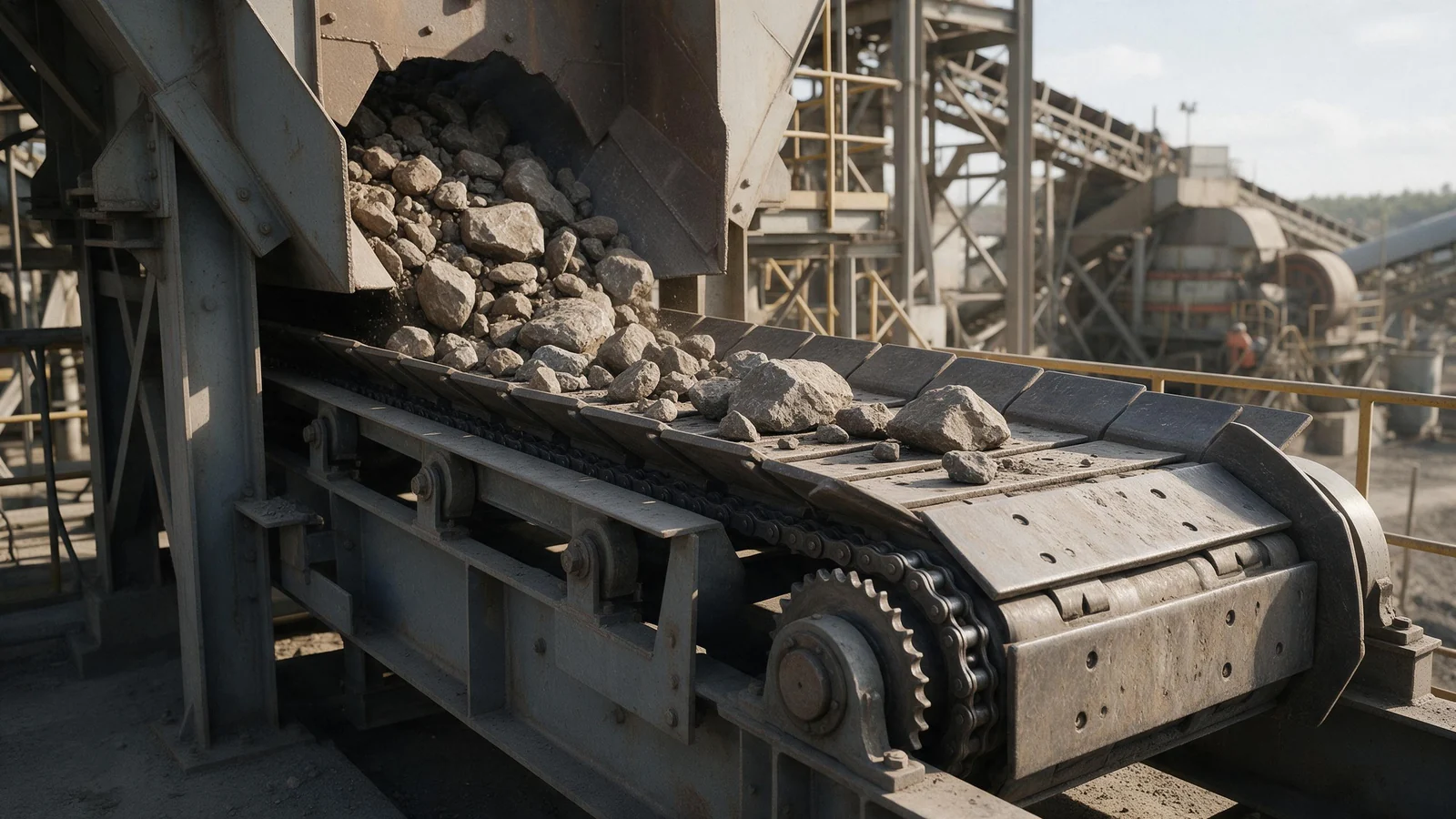
If you're specifying a feeder under a primary crusher dump pocket or a coarse ore bin, the apron feeder is usually the first machine you'll pick. It's designed for heavy, abrasive run-of-mine lumps that would tear a belt apart. The apron feeder — also called a plate feeder or heavy duty feeder — drags material on overlapping steel pans carried by two strands of heavy chain. You'll see them on nearly every large mining operation. Xinhai's feeding equipment range includes heavy-duty plate feeders built for this duty.
What is an apron feeder?
An apron feeder is a mechanical feeder that uses overlapping steel pans or plates mounted on two strands of heavy-duty chain to pull material from a hopper or bin and discharge it at a controlled rate. It's a type of positive-displacement feeder: each revolution of the drive sprocket moves a fixed volume of material. The pans form a continuous, segmented steel deck that can absorb impact and resist gouging. That's the core reason it differs from a belt feeder, where the rubber belt is the carrying surface.
Unlike a belt, the apron feeder doesn't rely on friction between the belt and the material. The chain does the pulling, and the pans carry the load. You'll find apron feeders under primary crushers, in front of SAG mills, and beneath coarse ore stockpiles.
Why it's the default under a primary crusher dump pocket
Impact loading is the decisive factor. Impact loading refers to the sudden, high-energy drop of rock onto the feeder surface from a haul truck or front-end loader. A 1.2-metre lump dropped from three metres can exert enormous point loads. A belt feeder's rubber belt cannot survive that repeated impact without punctures, tears, or splice failures. The apron feeder's thick steel pans are designed exactly for that shock. You'll also get abrasion resistance and the ability to handle tramp metal and sharp, angular rock.
Under a dump pocket, the feeder must also withstand the full weight of a live hopper. The pan and chain assembly transfers that load to the track and frame. That's why you'll see heavy structural frames and often hydraulic or mechanical take-ups on the tail section. Primary crushers demand this level of robustness because a feeder failure stops the whole circuit.
Pan width versus maximum lump size
Pan width is the first sizing variable you'll settle. The rule of thumb is that pan width should be 2 to 3 times the maximum lump size for slabby or blocky ore. Metso's apron feeder guidance uses a multiplier of about 2.5 times the largest particle for typical run-of-mine duty. So a 600 mm lump calls for a pan width around 1,500 mm. If the ore is sticky and contains a lot of fines, you may go to the wider end of that range to avoid bridging.
You also need clearance between the largest lump and the hopper side skirts. Usually you'll add 100 to 150 mm on each side to prevent wedging. The pan width then drives the hopper opening width and the downstream chute dimensions.
Speed range and drive selection
Apron feeder pan speed typically runs between 0.05 and 0.30 metres per second. FLSmidth's apron feeder documentation lists pan speeds up to 0.30 m/s for heavy-duty applications, while slower speeds suit extremely abrasive or sticky ores. Speed is usually controlled by a variable frequency drive (VFD) so you can adjust feed rate without changing the hopper gate. The drive must deliver high starting torque to break the material away from the hopper shear plane.
Drive power comes from chain pull, not just material weight. Chain pull is the force required to move the pans and the material against friction, hopper shear, and the inclined lift if any. You calculate it by summing the drag on the carry side, the return side, and the hopper discharge resistance. Multiply chain pull by pan speed to get the absorbed power, then apply service factors for shock and dirty conditions. Don't skimp on the drive; an undersized motor will trip on start-up under a full hopper.
Chain and flight considerations
The chain is the heart of the apron feeder. You'll choose between roller chains with attached flights and cast or fabricated pans bolted to the chain links. Track rollers support the chain on rails, and the tail end needs a take-up to maintain tension. Chain selection depends on the chain pull calculated earlier, the operating speed, and the expected abrasion. For very abrasive ore, you may specify hardened bushings and sealed rollers.
Flight spacing and pan overlap also matter. Overlapping pans prevent fines from sifting through onto the return deck, which would accelerate wear and cause carryback. You'll want replaceable wear bars on the pan underside where the chain rollers run, because that contact point is a high-wear zone.
Skirt and liner wear management
Skirts seal the gap between the hopper and the moving pans. They contain material and direct it onto the pans without spillage. But skirts are wear items. Abrasive ore will cut a groove along the pan edges and wear the skirt liners. Here's a four-step wear management sequence:
- Specify replaceable, adjustable skirt liners so you can maintain a tight seal as they wear.
- Use abrasion-resistant steel or rubber-ceramic composite liners on the pans in the impact zone.
- Monitor chain tension weekly; loose chains allow pans to sag and scrape the frame.
- Lubricate track rollers on the schedule the manufacturer recommends — missed lubrication is a common cause of premature chain and roller failure.
Liner life depends on ore hardness, impact energy, and feed rate. You'll extend it by controlling drop height and keeping the hopper from running completely empty, which causes direct pan impact without a material cushion.
Selection variables the buyer must supply
When you send a query for an apron feeder, include these variables in this order:
- Maximum lump size and shape (blocky, slabby, or round).
- Bulk density of the material, including moisture content.
- Required feed rate in tonnes per hour, with the intended speed range.
- Hopper opening dimensions and the total head load above the feeder.
- Material abrasiveness and any sticky or clay content.
- Downstream equipment type and its surge capacity needs.
- Installation geometry: horizontal or inclined, and the lift height.
Supplying these accurately lets the manufacturer calculate pan width, chain pull, motor power, and structural loads. Guessing any of them leads to a feeder that either stalls under load or runs half-empty and wears unevenly.
Apron feeder versus belt and vibrating feeders
Apron feeders are not the only choice. A belt conveyor works well for fine, dry, free-flowing material but fails under large impact lumps. A vibrating feeder is simpler and cheaper, but it cannot handle very large lumps or sticky material that arches and stops vibrating. The apron feeder is slower and heavier, but it's the only one that can start under a full, coarse, abrasive hopper load.
If your duty is under a primary crusher dump pocket or a coarse ore bin, don't try to save capital with a belt feeder. The maintenance cost will exceed the saving within the first year of operation. Choose the apron feeder for impact duty, a vibrating feeder for moderate lump sizes, and a belt feeder only for dry fines that won't damage the belt.
Frequently asked questions
What is the difference between an apron feeder and a belt feeder?
An apron feeder uses overlapping steel pans carried by chains and can handle large, sharp, abrasive lumps under heavy impact. A belt feeder uses a rubber belt that cannot survive that duty and is best for dry, fine, free-flowing material.
How do you determine apron feeder pan width?
Pan width is typically 2 to 3 times the maximum lump size, with roughly 2.5 times used for run-of-mine ore. You also add side skirt clearance of 100–150 mm on each side to prevent wedging.
What speed should an apron feeder run?
Heavy-duty apron feeders typically operate between 0.05 and 0.30 metres per second, controlled by a variable frequency drive. Slower speeds suit abrasive or sticky ore and reduce wear.
What are the main wear parts on an apron feeder?
The main wear parts are the pans, skirt liners, chain bushings, track rollers, and pan underside wear bars. Regular inspection, proper tension, and replaceable liners extend service life.
Send the duty, get a sized proposal
Tell us the ore, the throughput and the target product. Our process engineers come back with a flowsheet position, a model shortlist and the testwork we would need to confirm it.